Why DSR Isn’t the Final Answer
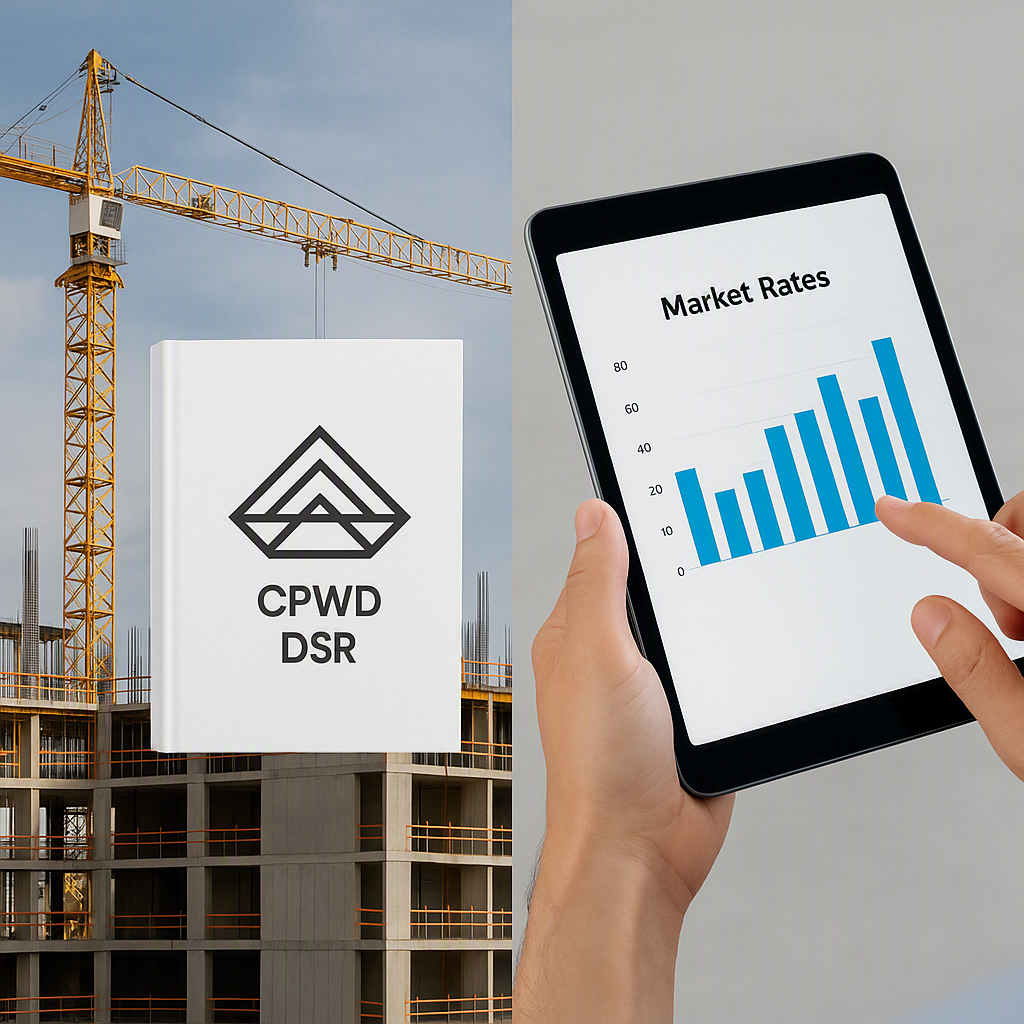
If you’ve ever tried estimating costs for a CPWD project, you know DSR rates are a mixed bag. They’re supposed to be standardized, but they rarely align perfectly with real-world market conditions. Why? Because DSR rates are indicative, not absolute. They’re based on controlled assumptions that don’t always match the ground reality.
For example, a CPWD DSR rate for M25-grade concrete might assume a fixed labour cost, material pricing, and regional inputs. But local market conditions, such as fluctuating material costs or regional labour demands, can make these standardized rates outdated. Relying solely on DSR can lead to underbidding—or worse, eroding your margins mid-project.
Key Factors Driving the Gap
So, what causes the gap between DSR and market rates? Let’s break it down:
-
Inflation and Time Indexing
DSR rates are tied to a specific year of publication. If you’re working with CPWD DSR from a prior year but bidding in a later year, those rates may already be out of sync. Applying an inflation adjustment based on general economic indices is critical. However, calculating the right uplift percentage can be challenging and requires careful consideration of market trends. -
Regional Variances
Labour and material costs vary drastically across India. For instance, the cost of reinforced steel or cement in a metropolitan area may differ significantly from that in a Tier-2 or Tier-3 city due to factors like logistics or supply chain constraints. Location-specific adjustments are essential to ensure accurate estimates. -
Market Volatility
Certain materials like steel, cement, and aggregates are highly volatile. A sudden surge in prices can render DSR rates irrelevant overnight. Without factoring in real-time market adjustments, your estimates risk being inaccurate. -
Scope and Special Conditions
DSR assumes standard work conditions. But what if your project involves working at night, under tight deadlines, or in a remote area? These special conditions demand premium pricing for labour, equipment, and logistics, none of which the DSR accounts for.
How to Bridge the Gap
Manually bridging the gap between DSR and market rates can be a complex process. It involves reviewing extensive documentation, applying inflation adjustments, and cross-referencing market data. Here are some general methods to simplify the process:
Practical Example: Inflation Uplift
Illustrative example — Suppose you’re estimating costs using CPWD DSR from a prior year. To adjust for inflation, you could apply a general uplift percentage based on economic indices or market trends. This adjustment ensures your estimates reflect current pricing levels.
Practical Example: Regional Adjustments
Illustrative example — If you’re pricing a project in a specific region, you might need to adjust DSR rates to reflect local labour and material costs. This could involve consulting local suppliers or industry reports to gather accurate data.
Common Mistakes to Avoid
-
Blindly Using DSR Rates
Never assume DSR rates are market-ready. Always check for inflation, location, and scope adjustments. -
Ignoring Audit Trails
Clients will question your rates. Without a clear audit trail, you’re left scrambling to justify your numbers. -
Underestimating Volatility
If your project relies heavily on volatile materials like steel, build in a buffer—or risk eating the cost later.
FAQ
Q1: How often should I update my rate adjustments?
At least quarterly or whenever there’s significant market movement.
Q2: Can DSR rates work for private projects?
Yes, but with heavy adjustments. Private clients often expect market-aligned rates, not government-standard ones.
Q3: What’s the best way to handle special conditions not covered in DSR?
Add a markup for each special condition—night work, remote locations, etc. Quantify these adjustments based on project-specific factors.
Final Thoughts
DSR rates are a great starting point, but they’re not the full story. Accurate estimation requires bridging the gap with inflation indexing, regional adjustments, and real-time market data. Leveraging tools or structured methodologies can simplify this process, turning a complex workflow into something manageable—and accurate.