How to Use CPWD DSR in Other States: Key Adjustments Contractors Must Know
If you’ve ever bid on a public works project in India, you’ve likely wrestled with the CPWD DSR (Delhi Schedule of Rates). These standardized rates are essential for estimating costs on government tenders. But here’s the catch: CPWD DSR is designed for Delhi. When you take it to other states, you can’t just copy-paste the numbers. Inflation adjustments, regional market conditions, and local compliance all come into play. Get it wrong, and you’re either overpricing your bid or setting yourself up for margin erosion.
So how do you adapt CPWD DSR for use in other states? Let’s break it down.
The Problem: CPWD vs. State Context
The CPWD DSR catalogs were created with Delhi’s market in mind. But in Maharashtra, Tamil Nadu, or Rajasthan, material and labor costs vary significantly. For example:
- Material Costs: Cement in Delhi might cost ₹300 per bag, but in Tamil Nadu, it could be ₹330 due to transportation or local taxes.
- Labor Costs: Delhi’s rates are based on its labor compliance norms. States like Gujarat or Bihar may have different minimum wages or workforce availability.
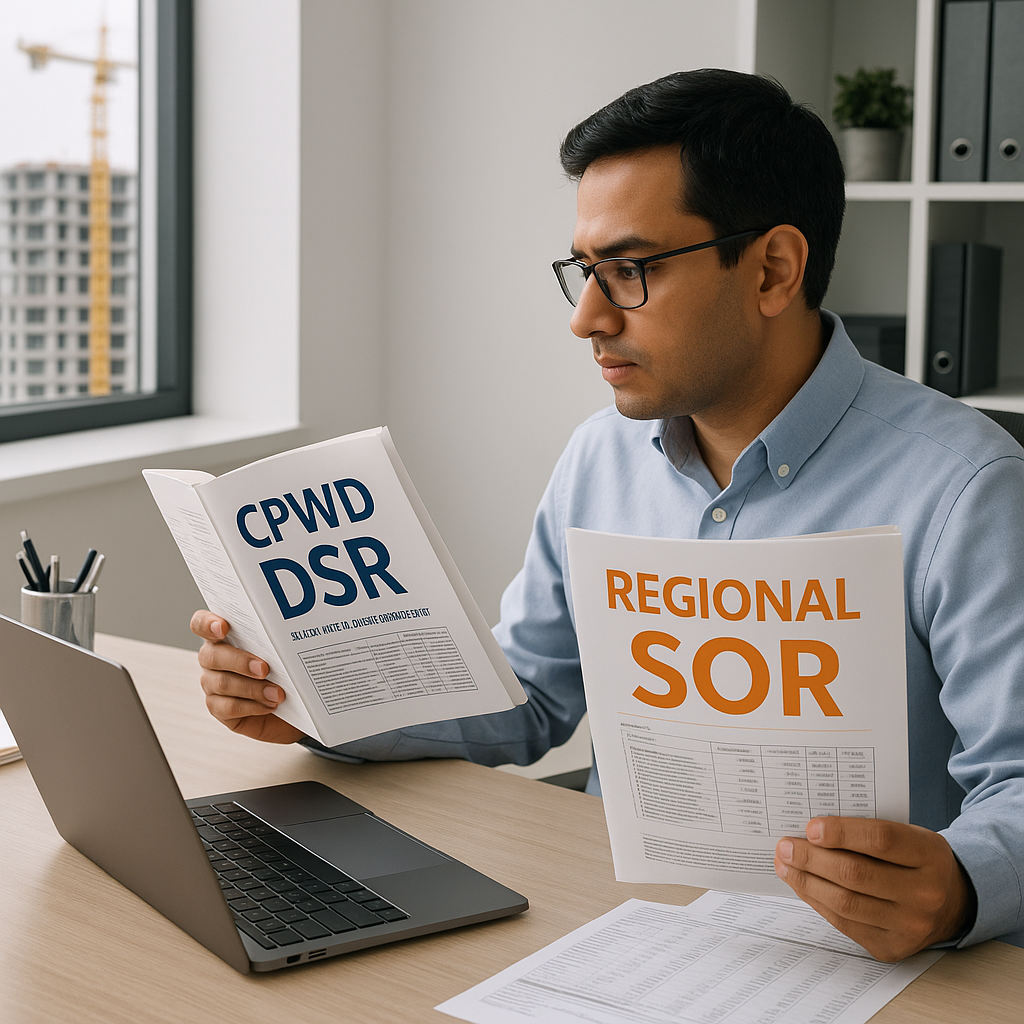
- Regional SOR Integration: States often publish their own PWD SORs (Schedule of Rates). Maharashtra’s PWD SOR, for instance, includes unique items not covered by CPWD.
Case Study: Cement Cost Variations Across States
Take the example of a contractor estimating costs for a road project. Cement prices in Delhi hover around ₹300 per bag, but in Maharashtra, taxes and transportation costs drive this up to ₹340. In Rajasthan, where limestone is locally sourced, the price drops to ₹280. Without adjusting for these differences, a Delhi-based contractor could overbid in Rajasthan or underbid in Maharashtra.
Actionable Steps:
- Check Regional Material Prices: Use local suppliers or state PWD data to get accurate rates.
- Labor Compliance: Verify wage laws and workforce availability in the target state.
- Cross-reference Regional SORs: Compare CPWD DSR with state-specific PWD SORs to identify gaps or mismatches.
The Manual Process: Painful and Time-Consuming
Let’s look at how this typically works without tools. Say you’re bidding on a ₹20 crore project in Maharashtra. The tender specifies CPWD DSR as the base, but you must:
- Find the Latest CPWD Circulars: Identify the applicable Cost Index (CI) adjustments for inflation.
- Compare CPWD with Maharashtra PWD Rates: Cross-check regional items manually.
- Apply Adjustments to Each BOQ Line: For 300+ line items, you’ll spend hours recalculating rates.
The result? Most contractors waste 10-15 hours per estimate on manual adjustments. And errors creep in, especially with GST compliance or inflation uplifts.
Example: Manual Adjustments for BOQ
Consider a ₹1 crore building project in Gujarat. The BOQ contains 150 line items, including:
- RCC Slabs
- Brick Masonry
- Plastering
Without automation, you’d need to manually:
- Calculate the inflation-adjusted CPWD rates.
- Match each BOQ line item with Gujarat PWD rates.
- Address GST compliance for each material.
This process could take 20+ hours and is prone to errors—especially if you’re working on tight deadlines.
Actionable Steps:
- Use Excel Templates: Create formulas for inflation adjustments and SOR comparisons.
- Divide and Conquer: Split BOQ items among team members to speed up the process.
- Cross-check GST Rules: Ensure each item complies with the latest tax regulations.
The Solution: Automating Adjustments with AI Tools
This is where tools like EstimateNext come in. Designed for multi-region use, it simplifies CPWD DSR adjustments in three key ways:
1. Smart BOQ Parsing
Upload your BOQ (Excel, CSV, or PDF), and the system auto-detects hierarchies, merged cells, and duplicate entries. It’s like having a junior QS clean up your files overnight.
2. 4-Step SOR Matching
EstimateNext uses AI to match BOQ items with:
- CPWD DSR Rates (latest version).
- Regional PWD SORs: Maharashtra, Karnataka, etc.
- Tenant History: Your own past rates.
- Fallback Logic: AI suggests the closest match if no direct item exists.
Example Table: RCC Slab Rate Matching
| Source | Rate (₹/m³) | Confidence |
|---|---|---|
| CPWD DSR Civil Vol I | ₹6,200 | 100% |
| Maharashtra PWD SOR | ₹6,500 | 85% |
| AI Recommended | ₹6,400 | 70% |
You can pick the rate, adjust manually, or let the system auto-apply.
3. Inflation and Compliance Adjustments
The platform applies Cost Index (CI) and GST rules automatically. For example:
- Inflation Uplift: It applies a 12% CI adjustment if the CPWD circular specifies it.
- GST Compliance: It flags items requiring reverse charge mechanisms (RCM) or IGST vs. CGST splits.
This automation slashes rate adjustment time from hours to minutes.
Real-World Example: Maharashtra Bids
Imagine you’re bidding on a ₹50 crore Maharashtra highway project. The tender specifies CPWD DSR 2018 as the base but requires compliance with the state’s SOR. Without tools, you’d:
- Spend 20+ hours reconciling CPWD and Maharashtra rates.
- Miss tender deadlines due to manual recalculation.
- Risk non-compliance if you forget a GST rule.
With EstimateNext, you’d upload the BOQ, select “Maharashtra MarketProfile,” and get adjusted rates in minutes. It’s not just faster—it’s more accurate.
Actionable Steps:
- Automate BOQ Parsing: Use software tools to avoid human errors.
- Leverage AI for Rate Matching: Save time and improve accuracy.
- Stay Updated: Tools like EstimateNext track inflation and compliance updates for you.
Why This Matters
According to this JobNext blog, contractors lose ₹25 lakh annually to manual errors. Rate mismatches, outdated indexes, and GST mistakes all add up. By automating CPWD DSR adjustments, you eliminate these risks.
FAQ
1. Can CPWD DSR be used directly in other states?
No. CPWD DSR is a baseline. You must adjust for state-specific SORs, inflation, and compliance to avoid bid rejections.
2. How often does CPWD update its Cost Index?
Typically once or twice a year. Keeping up manually is tough, which is why tools like EstimateNext track updates for you.
3. What happens if I ignore regional adjustments?
You risk underpricing materials or labor, leading to margin erosion. Worse, your bid could be non-compliant and rejected.
4. Are AI tools expensive for contractors?
Not necessarily. Many tools offer tiered pricing based on project size, making them accessible even for small contractors.
5. Can AI tools handle multi-state projects?
Yes. Tools like EstimateNext are designed to manage SOR variations across multiple regions, saving time and ensuring compliance.
Comparison: Manual vs. Automated Adjustments
| Criteria | Manual Adjustments | Automated Tools (e.g., EstimateNext) |
|---|---|---|
| Time Spent | 10-20 hours per estimate | 15-30 minutes |
| Error Risk | High | Low |
| Compliance Tracking | Manual | Automated |
| Cost Index Updates | Requires manual lookup | Auto-applied |
| Multi-State Support | Limited | Comprehensive |
Call to Action
If you’re tired of wasting hours on CPWD DSR adjustments, EstimateNext can help. Upload your BOQ, apply regional adjustments, and get compliant estimates in minutes. Get started free →