Why BOQ Alignment with CPWD Standards Matters
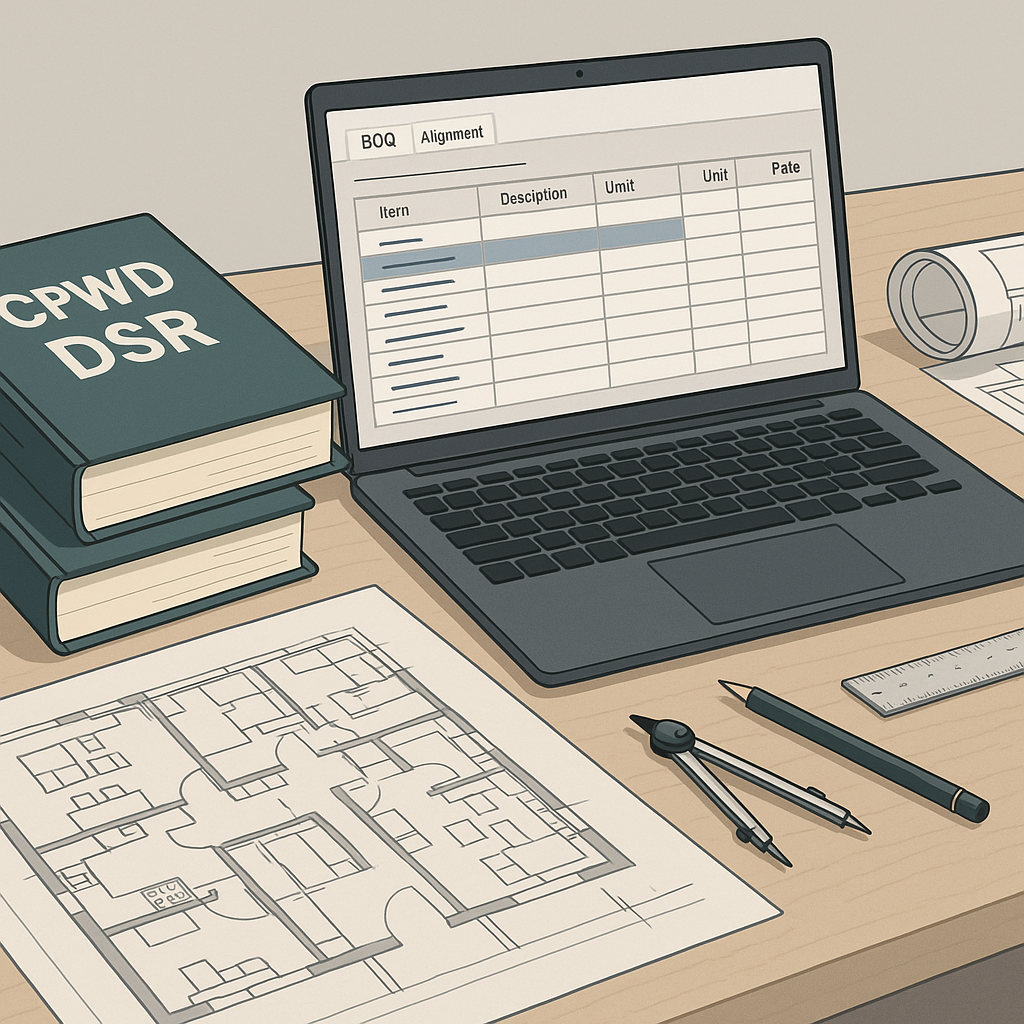
Every CPWD tender specifies its own rules, and failing to align your BOQ (Bill of Quantities) with those standards can cost you the bid. If your rates don’t match the DSR (Delhi Schedule of Rates) or your structure is inconsistent, you’re putting your project at risk. Yet manually aligning BOQs is a tedious process. Contractors waste hours flipping through PDFs, cross-checking rates, and reworking Excel sheets. Sound familiar?
Here’s the good news: it doesn’t have to be this hard. Whether you’re dealing with civil works, MEP tasks, or fit-out jobs, there’s a systematic way to get it right.
Step-by-Step BOQ Alignment Workflow
1. Start with a Clear BOQ Structure
A solid BOQ starts with clarity. Think hierarchy:
- Main Categories: Civil Works, MEP (Mechanical, Electrical, and Plumbing), Finishes
- Subcategories: Concrete, Masonry, HVAC, Electrical Wiring
- Line Items: 200mm RCC Slab, AHU (Air Handling Unit) Installation, Electrical Conduit Installation
This structure ensures every item is traceable and matches the CPWD format. For example, CPWD uses subcategories like “Plastering” or “Flooring” under Civil Works. If your BOQ skips this hierarchy, your bid might fail compliance checks.
Actionable Steps:
- Use software or templates that enforce hierarchical structures.
- Create a checklist for aligning subcategories with CPWD standards.
- Review CPWD BOQ samples to ensure your structure matches their expectations.
Tip: Tools like EstimateNext auto-detect merged cells and headers during BOQ upload, ensuring correct alignment with CPWD categories.
2. Match Rates to CPWD DSR
Manually flipping through the 2,000-page DSR PDF to find rates for every line item is exhausting. Yet, matching your rates to DSR is non-negotiable for CPWD compliance.
How to Match Rates Efficiently:
- Use Searchable Databases: Tools like EstimateNext’s 78K-item catalog include CPWD DSR and 26 state-specific SORs (Schedule of Rates). This allows you to find matches instantly.
- Apply Inflation Factors: CPWD updates its Cost Index periodically to account for inflation. Ensure you adjust rates accordingly.
- Use Semantic Search: Instead of scrolling through PDFs, enter descriptive keywords (e.g., "vitrified tiles") into the tool to instantly retrieve the rate.
Example: Say you need a rate for “vitrified tiles for flooring.” Using a searchable database, you input the item name, and the tool returns the DSR rate along with options for regional adjustments. This eliminates manual errors and saves hours.
Comparison: Manual vs. Automated Rate Matching
| Method | Time Required | Accuracy | Ease of Use |
|---|---|---|---|
| Manual PDF Search | High | Moderate | Difficult |
| Automated Database Search | Low | High | Easy |
3. Audit Your Build-Up
CPWD tenders often require transparent rate breakdowns, which means you need well-documented calculations for each item. This includes:
- Material Cost: Rates for materials sourced from DSR.
- Labour Cost: Skilled/unskilled rates from CPWD’s DAR (Delhi Analysis of Rates).
- Equipment Cost: Depreciation, fuel, and operator charges.
How to Ensure Accurate Audits:
- Use tools that generate audit trails for every rate.
- Cross-reference material and labour costs with the latest DSR and DAR.
- Document equipment costs using pre-defined depreciation rates.
Tip: EstimateNext provides a full calculation path for every rate, including its source, component totals, and the final breakdown.
4. Standardize Outputs
Messy deliverables kill client trust. CPWD-compliant BOQs should include:
- Summary Sheets: High-level breakdown of categories and costs.
- Detailed Sheets: Line-by-line rates, quantities, and totals.
- Audit Trails: Documentation of rate sources and calculations for transparency.
Actionable Steps for Formatting:
- Use consistent fonts, headers, and table formatting.
- Add source references for every rate.
- Export directly to CPWD-compliant formats using software tools.
If you’re using Excel, prepare to spend hours formatting. Alternatively, use tools like EstimateNext that export to CPWD DSR format, eliminating rework.
5. Handle Scope Changes Without Breaking Your BOQ
CPWD tenders often involve mid-process changes—additional scope, revised specs, or updated rates. If your BOQ isn’t adaptable, you’ll be stuck rebuilding spreadsheets.
How to Manage Scope Changes:
- Use Linked Formulas: Ensure cost adjustments propagate automatically across your BOQ.
- Leverage Adjustable Cost Factors: Update inflation rates or labour costs without manual rework.
- Track Changes: Use software that logs scope changes and their impacts on costs.
Tip: EstimateNext allows real-time updates to rates and quantities, ensuring consistency without manual intervention.
Common Mistakes Contractors Make
1. Ignoring CPWD Hierarchies
Skipping subcategories like “Plastering” or “Flooring” might seem harmless but leads to compliance issues.
2. Using Outdated DSR Rates
Rates change annually. If you’re pulling numbers from old PDFs, your bid could be overpriced—or worse, underpriced.
3. Messy BOQ Formats
Bids with inconsistent formatting and untraceable calculations frustrate reviewers and reduce your chances.
FAQs
Q1: How often should I update my BOQ rates?
At least quarterly or whenever CPWD issues a new Cost Index circular. EstimateNext automates this with CPI-based suggestions.
Q2: What’s the difference between DSR and DAR?
DSR provides item rates for materials, while DAR focuses on labour rates. Both are critical for CPWD compliance.
Q3: Can I reuse the same BOQ template across tenders?
Yes, but ensure you adjust rates and align subcategories to match the specific tender’s requirements.
Q4: What’s the easiest way to switch materials in a BOQ?
Use tools like EstimateNext that let you swap materials and see cost impacts instantly.
Q5: How do I format a CPWD-compliant BOQ?
Follow the hierarchy—Main Categories, Subcategories, Line Items. Exporting via estimation software ensures compliance without manual formatting.
Decision Framework: When to Use Automation for BOQ Alignment
| Scenario | Manual Approach | Automated Tools |
|---|---|---|
| Large tenders with 500+ line items | Time-consuming, error-prone | Fast, accurate |
| Frequent scope changes | Requires rework | Real-time updates |
| Compliance with specific CPWD hierarchies | Requires constant checking | Auto-alignment |
| Updating rates to match new CPWD DSR or DAR | Manual lookup required | Instant updates |
The Bottom Line
Aligning your BOQ with CPWD standards doesn’t have to be a manual headache. From structure to rate matching, tools like EstimateNext streamline the process, saving hours and reducing errors.
If you're tired of wasting time on BOQs, EstimateNext is built for this exact workflow. Get started free →