
The Silent Margin Killer: Disconnected Systems
Let’s be blunt. Most contractors don’t realize how much money they’re losing until the year-end books are reviewed. Margins are razor-thin in construction — typically between 2% and 7% for most mid-size contractors. Yet, disconnected systems are quietly bleeding profits out of your projects.
You might think, “We’ve got software for everything — Excel for estimates, Tally for accounting, WhatsApp for site updates.” But that’s exactly the problem. These tools don't talk to each other. And when systems don't integrate, gaps form. Gaps where costs get misreported, invoices are delayed, and procurement overruns happen. Sound familiar?
The Numbers Don’t Lie
In a survey by JBKnowledge, 22% of contractors admitted they spend at least 8 hours a week manually transferring data between systems. That’s one full workday wasted — per week. Multiply that by the hourly rates of your project managers, accountants, and site engineers. Now add the cost of errors introduced during manual re-entries — missed billings, incorrect payroll, double payments. This easily snowballs into millions of rupees in lost revenue for companies managing multiple projects.
And here’s the kicker: You don’t even realize it’s happening until it’s too late.
What’s the Fix? A Unified ERP
The solution isn’t adding more tools. It’s consolidating them. This is where a unified, cloud-based ERP platform like JobNext becomes critical. Instead of juggling separate systems for tendering, procurement, billing, HR, and finance, you get one platform that handles it all.
Take procurement chaos, for instance. In most setups, material requisitions (MRs) are emailed, RFQs are managed in Excel, and purchase orders (POs) are tracked manually. Approvals? Usually a mix of WhatsApp messages and phone calls. This unstructured approach is a recipe for budget overruns and supplier disputes.
With JobNext, the workflow is completely structured: MR → RFQ → Vendor Offers → PO, all tracked in a single system. Approvals are automated with multi-level workflows, so nothing moves forward without accountability. One client reported cutting procurement cycle times by 35% after switching to this system.
Real-Time Cost Tracking = No More Surprises
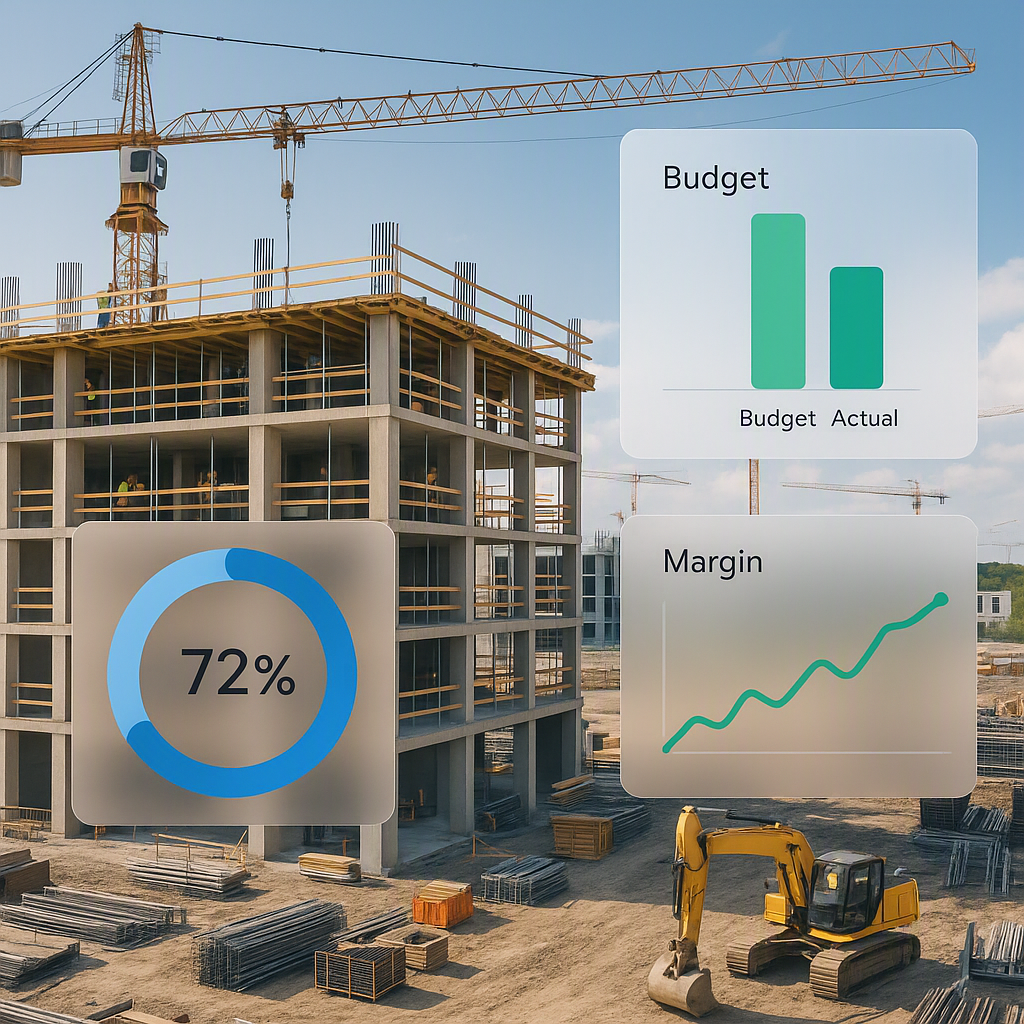
Another area where unified ERPs shine is cost tracking. Let’s say you’re managing five projects simultaneously. Can you tell, right now, which ones are profitable? Most contractors can’t. They rely on quarterly reports to assess profitability — by which time, the damage is already done.
JobNext changes this by giving you real-time project profitability monitoring. It integrates BOQs, scopes, and estimates with actual costs incurred. You can pinpoint where margins are eroding — whether it’s labor, materials, or subcontractors — and course-correct immediately. This isn’t just theory. According to JobNext's blog, contractors using cloud ERPs have seen up to 20% faster project execution and fewer budget overruns.
Why Cloud ERP? Because Scalability
You might ask, “Why go cloud? Why not stick to on-premise software?” The answer is scalability. On-premise systems are rigid. Expanding to multiple sites or adding new workflows often requires expensive customizations. Cloud ERPs, by contrast, grow with your business. Need to onboard a new site in Oman or Saudi Arabia? No problem. JobNext handles multi-currency, multi-country operations seamlessly — including compliance with GCC regulations like VAT and WPS payroll.
Managing Multi-Country Construction Operations: ERP Strategies for International Contractors dives deeper into this, showing how contractors can avoid compliance failures and financial surprises when scaling internationally.
The Obvious Objection: Cost
You might be thinking, “This sounds expensive.” And you’re right — ERPs aren’t cheap. But neither are fragmented systems. A 2023 Nucleus Research study found that businesses see an average of $7.23 returned for every $1 spent on modern ERP systems. Why? Because they eliminate inefficiencies that cost much more than the software itself.
For small to mid-size contractors, the ROI becomes evident within the first year. One contractor we worked with recovered ₹25 lakhs in missed billings simply by switching to JobNext’s stage-wise billing module. That’s not a fluke — it’s the result of structured workflows replacing manual chaos.
Final Thoughts
Disconnected systems might feel manageable when you’re running one or two projects. But as you scale, they’ll quietly chip away at your margins, project by project. A unified ERP isn’t just a nice-to-have. It’s an operational necessity for contractors serious about profitability.
If you’re still on the fence, I’d recommend starting small. Implement JobNext for one aspect — say, procurement or billing — and measure the results. Once you see how much smoother things run, scaling it across your operations becomes an easy decision.
Want to learn more about how cloud ERPs prevent margin erosion? Check out this detailed guide: Why Contractors Are Losing Margins Without Cloud ERP.
Ready to see JobNext in action?
Multi-tenant SaaS ERP for construction, facilities management, and contracting — covering preconstruction, project execution, procurement, HR & payroll, equipment, finance, and 150+ analytics reports.
Get Started Free →