
Why ROI on Construction Software Isn’t Just About Numbers
Let’s start with the obvious: calculating ROI isn’t the only way to measure the success of a construction software investment. But if you skip it, you’re flying blind. Most contractors we’ve worked with either:
- Overcomplicate the process, drowning in spreadsheets they’ll never revisit.
- Or worse, skip the calculation entirely, relying on vague feelings like, “It seems faster now.”
Neither works. What you need is a clear, actionable framework — and the discipline to track results over time.
The Formula (and Why It’s Simpler Than You Think)
The basic ROI formula is straightforward:
ROI (%) = [(Net Return on Investment) / (Total Investment Cost)] x 100
For software, let’s break that down:
- Net Return: The measurable financial benefits (e.g., cost savings, revenue gains, reduced overruns).
- Investment Cost: The total cost of ownership, including licenses, training, and implementation.
Sounds easy, right? Except for one issue: many benefits are indirect or hard to quantify. How do you measure ‘time saved’ or ‘fewer errors’? This is where most ROI efforts go off the rails.
A Real Example: Tackling Margin Erosion with JobNext
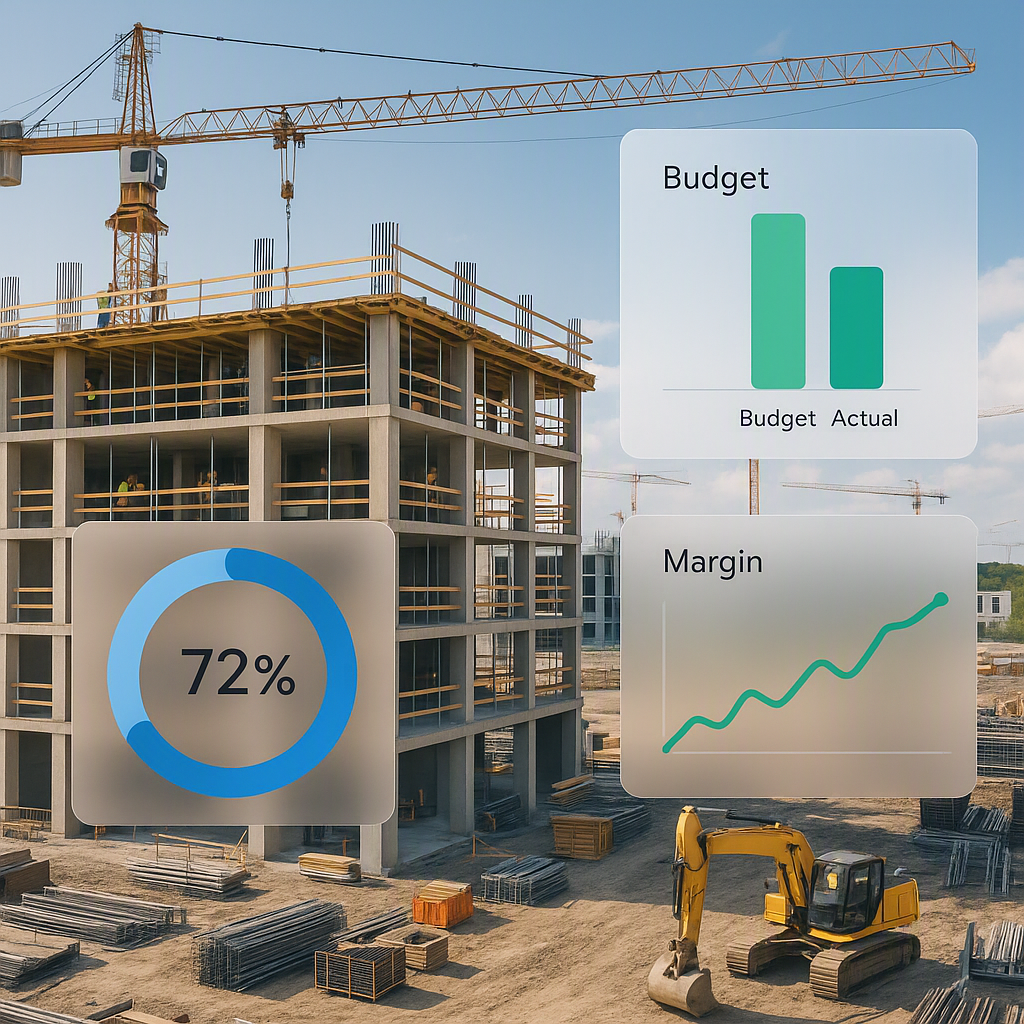
Let’s take a real-world problem: margin erosion. Contractors often lose money because they don’t track project costs properly. A 2022 report by Construction Executive found that 35% of contractors reported profit margins below 2%. That’s razor-thin, even for this industry.
How JobNext Solves This
JobNext’s real-time project profitability tracking tackles this head-on. Here’s how:
- BOQ-WBS-Resource Hierarchy: You set up your project’s Bill of Quantities (BOQ) and Work Breakdown Structure (WBS) with resource allocations upfront. This lets you track costs at a granular level.
- Real-Time Dashboards: Instead of waiting for month-end reports, you see cost overruns as they happen. One client we worked with, a mid-size HVAC contractor in Dubai, caught a $50,000 subcontractor overrun within 3 days — simply because their dashboard flagged it.
- 150+ Analytics Reports: From material consumption to scope deviations, you get actionable insights without digging through Excel sheets.
ROI Breakdown: A Practical Calculation
Here’s how you might calculate ROI for a contractor using JobNext to address margin erosion:
| Metric | Value |
|---|---|
| Annual Revenue | $10,000,000 |
| Average Project Margin | 5% |
| Annual Profit (Pre-Software) | $500,000 |
| Margin Gained Post-Software (1% Lift) | $100,000 |
| Annual Cost of JobNext Subscription | $30,000 |
| Implementation + Training Costs (Year 1) | $15,000 |
| Total Year 1 Investment | $45,000 |
| Net Return (Year 1) | $55,000 |
| ROI (Year 1) | 122% |
In this example, the contractor sees a 122% ROI in the first year — and that’s conservative. It doesn’t include savings from reduced errors, faster billing, or better equipment utilization.
What About Non-Quantifiable Benefits?
You might be thinking: what about things you can’t measure with a dollar sign, like better compliance or happier employees? Good question.
Here’s the hard truth: Non-quantifiable benefits are great, but they can’t justify an investment alone. Use them as a bonus — the cherry on top of your ROI calculation. For instance, JobNext’s Tally integration ensures GST/TDS compliance in India, which reduces risk. While you can’t always assign an exact dollar value to ‘avoided penalties,’ it’s a no-brainer that compliance is better than the alternative.
Common Pitfalls (and How to Avoid Them)
1. Forgetting the Full Cost
Many contractors only consider the software license fee. Don’t. Include implementation, training, and even the cost of switching from your old system. CMiC Global breaks this down into direct and indirect costs — worth reading.
2. Ignoring the Learning Curve
ROI doesn’t happen overnight. It often takes 6-12 months to see meaningful results, as highlighted in our post, ERP Implementation for Contractors: The Phased Approach That Actually Works. If you’re not committed to the long haul, don’t bother.
3. Underestimating Adoption Challenges
Even the best software fails if your team doesn’t use it. A Construction Executive article noted that user adoption issues derail 42% of software projects. The key? Invest in training and pick tools with intuitive UIs. JobNext’s role-based access ensures each team member only sees what’s relevant — reducing overwhelm.
Final Thoughts: Measure, Adjust, Repeat
Measuring ROI isn’t a one-and-done deal. Track your metrics quarterly. Adjust your processes based on what’s working (or not). And remember: the best software doesn’t just solve today’s problems — it prepares you for tomorrow’s challenges.
For more on how contractors can modernize effectively, check out our guide: Construction Digital Transformation: A No-Nonsense Roadmap for Mid-Size Contractors.
Want to see how JobNext can help your projects? Learn more here.
Ready to see JobNext in action?
Multi-tenant SaaS ERP for construction, facilities management, and contracting — covering preconstruction, project execution, procurement, HR & payroll, equipment, finance, and 150+ analytics reports.
Get Started Free →